Cosmological simulations have recently begun to quantify the halo-to-halo variance in the phase-space distribution of dark matter around the Sun.
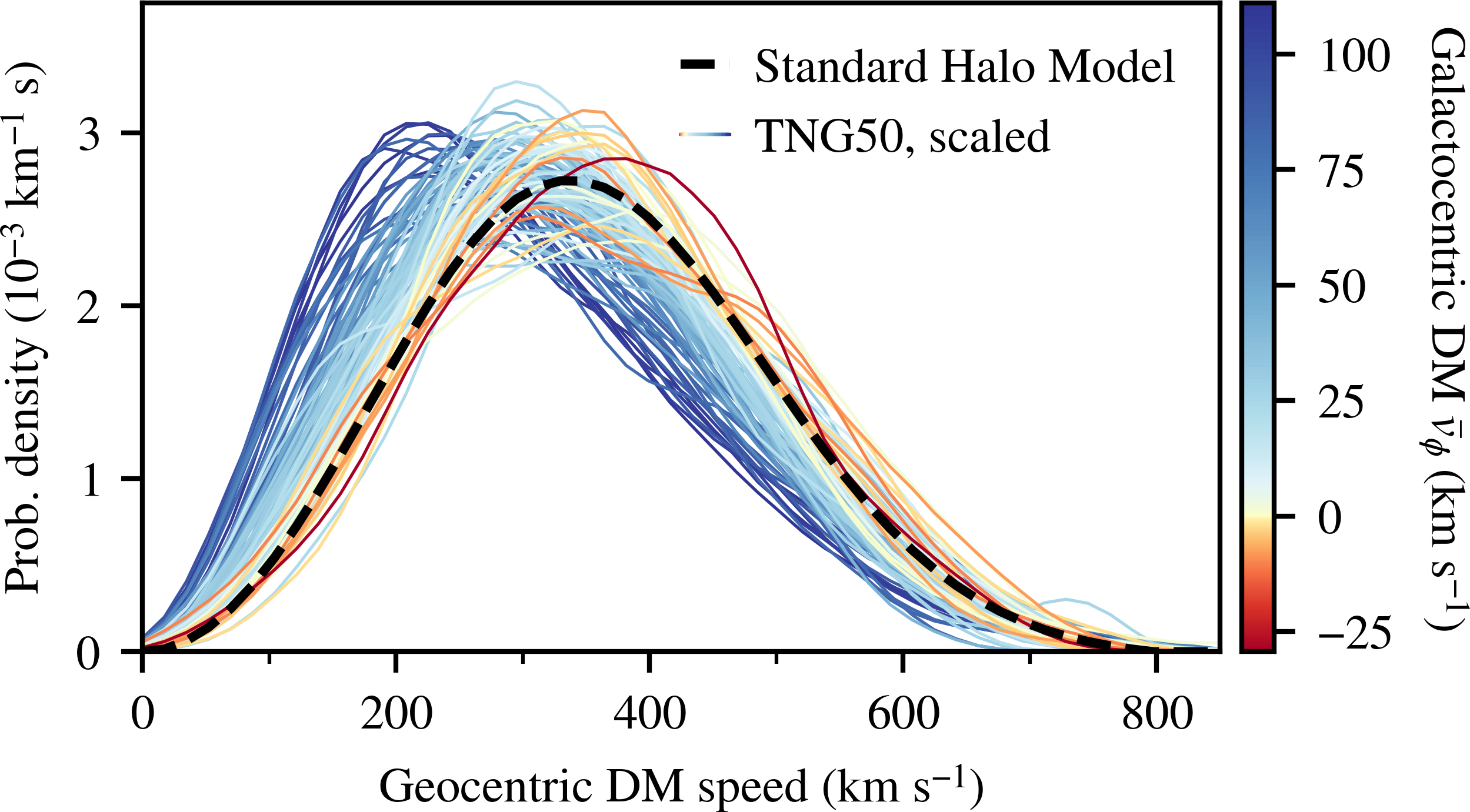
We use a sample of nearly one hundred Milky Way–like galaxies from the TNG50 simulation to determine what aspects of this variance control the predictions for dark matter direct detection. Contrary to the isotropy assumed in the standard halo model, we find the dark matter median azimuthal velocity is nonzero and preferentially corotating, i.e., in the direction of the baryonic disk’s rotation, ranging from 6–70 km/s (16th–84th percentile). This corotation suppresses predicted scattering rates in laboratory experiments searching for dark matter lighter than 50 GeV and significantly affects the expected daily modulation amplitude for directional detectors. In particular, this induces a 21% uncertainty on the upper limit of the dark matter–nucleon interaction cross section at peak sensitivity for a typical isotropic ton-scale experiment.
This uncertainty is not irreducible, however: it is strongly correlated with the rotational velocity. If studies of the Milky Way’s formation history determine the rotation speed, this astrophysical uncertainty is reduced to 7%.